Why Retail Media ROAS Makes High-Intent Channels Always “Win” in the Dashboard
As part of our ongoing series on growth and measurement for CPG brands, we’ve been unpacking how different metrics shape strategy.

In our last post, we explored why ROAS is useful but often over-weighted. Now let’s look at a related pattern most teams have seen firsthand.
Some channels almost always appear to outperform the rest:
Paid search
Retailer onsite ads
Sponsored products
Instacart placements
Their ROAS is higher, conversion rates are stronger, and their dashboards look cleaner.
It feels obvious where budget should go.
But that conclusion deserves a closer look.
Where These Channels Sit in the Journey
High-intent channels operate closest to the moment of purchase.
Search reaches people actively looking for a product, retail media reaches shoppers already inside a retailer ecosystem, and Instacart ads reach consumers building a cart in real time.
These environments capture demand at the bottom of the funnel and that proximity naturally produces stronger attributed efficiency.
The shopper was already close to buying ad the ad simply intercepts them at the right moment.
Demand Capture vs Demand Creation
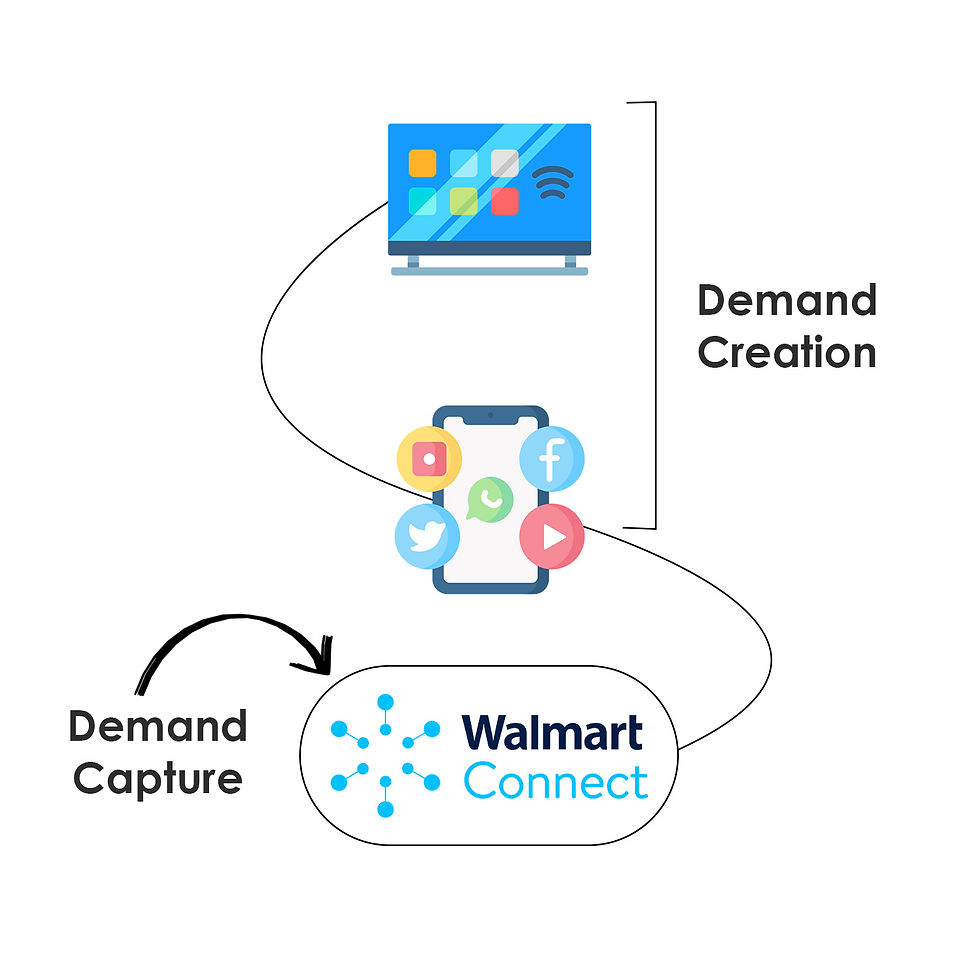
It’s important to separate two different roles in media.
Demand creation expands the audience. It builds awareness, memory, and mental availability. It reaches consumers who may not be actively shopping at that moment.
Demand capture intercepts consumers already in a buying mindset.
High-intent channels specialize in capture.
That does not make them less valuable, it just makes them different.
The confusion begins when capture is mistaken for creation.
If a shopper saw a connected TV ad last week, noticed social content yesterday, and clicked a retail media placement today, the last interaction typically gets the credit.
The upstream channels made the shopper receptive and the downstream channel closed the loop. The dashboard shows the closer, but doesn't show the buildup.
Why Retail Media ROAS Looks Stronger Here
High-intent channels often show stronger ROAS because:
The audience is already warm
The purchase window is short
The attribution path is clean
The platform can see the transaction directly
That structural advantage does not mean those channels are driving all the demand.
It means they are well-positioned to receive credit.
When brands shift too much budget toward the highest visible retail media ROAS environments, they often narrow the top of the funnel.
Initially, performance looks efficient.
But, eventually, audience saturation increases and incremental growth becomes harder to achieve.
The Drafting Effect
There is another dynamic at play.
High-intent channels often “draft” off broader media investment.
When brand media increases awareness, search volume rises
If upper-funnel exposure builds familiarity, conversion rates improve
When social or video expands reach, retail media becomes more effective
When that happens, the downstream channel appears to be the hero, but you can't ignore that it's benefiting from the upstream lift.
This is why incremental lift studies often show stronger portfolio impact than platform-level ROAS alone would suggest.
Why This Matters for Budget Decisions

The natural reaction is to reallocate budget toward whatever shows the strongest efficiency.
Sometimes that's appropriate, but if demand capture expands while demand creation contracts, the system becomes unbalanced.
Short-term returns may improve while long-term expansion may slow.
The performance plateau we discussed earlier typically begins here.
The channel didn't fail. Instead, the mix narrowed too far.
Using High-Intent Channels Strategically
High-intent channels are essential because they:
Capture ready shoppers
Convert interest into sales
Provide fast feedback
Drive near-term revenue
But they perform best when layered on top of healthy demand creation.
When the funnel is full, capture works harder.
When the funnel narrows, capture competes over the same buyers.
The dashboard will not warn you when this shift begins, but penetration and lift usually will.
The Balanced View
The goal isn't to reduce investment in high-intent environments, it's to recognize their role.
They are closers.
They are not always generators. But, when they are, performance will diminish over time because you're reaching the same people over and over.
When brands understand that distinction, media allocation becomes more disciplined.
Instead of chasing the highest ROAS in isolation, teams can evaluate how the full system works together.
In our next post, we’ll explore another common misstep: comparing ROAS across fundamentally different channels as if they are directly interchangeable.
We are Left Hand Agency, a CPG media buying agency helping brands grow with short and long-term strategies. Our memory-driven strategies deliver results your marketing and finance teams will champion.