
The Power of Staying Private: What the World’s Largest Private CPG Companies Teach Us About Growth
- May 1
- 6 min read
In a category dominated by publicly traded giants, a small group of privately owned CPG companies have quietly built some of the most powerful brands in the world. Mars, Ferrero, McCain Foods, Wonderful Company, and Red Bull did not follow the typical path of scale, exit, and shareholder pressure. Instead, they grew deliberately, often over decades, balancing brand investment, supply chain control, and long-term thinking in ways most public companies simply cannot.
This is not a story about speed. It is a story about patience, conviction, and the structural advantages of staying private.
Mars: The Blueprint for Compounding Brand Power

Mars is the clearest example of what long-term private ownership can unlock. Founded in 1911 as a small candy business, the company built its foundation on a series of iconic products including Snickers, M&M’s, and Milky Way. Today, following its landmark $36 billion acquisition of Kellanova in late 2025, Mars has evolved into a global snacking titan with annual revenues exceeding $65 billion.
What stands out is not just this new, massive scale, but a relentless consistency. Mars has historically reinvested heavily in advertising and brand building, maintaining category leadership through sustained share of voice rather than short-term bursts. While public competitors often slash marketing spend to protect quarterly dividends, Mars treats advertising as a non-negotiable long-term asset.
This patience allowed them to strategically integrate Kind and build a massive pet care ecosystem (including Pedigree and VCA hospitals). Now, with the addition of snack icons like Pringles and Cheez-It, Mars can apply its signature long-term playbook to the savory aisle. Private ownership gives Mars the permission to ignore the integration panic that haunts public mergers, focusing instead on compounding brand equity over decades rather than quarters.
Ferrero: Winning Through Patient Acquisition and Brand Reinvestment

Ferrero began as a small Italian pastry business in 1946 and grew into a global snacking leader with annual revenue of approximately $21 billion. While its foundation was built on brands like Nutella, Kinder, and Ferrero Rocher, its North American presence has expanded significantly through acquisitions. Beyond Nestlé’s U.S. candy business (including Butterfinger and Nerds), Ferrero recently made its largest move yet by acquiring WK Kellogg Co in late 2025, adding iconic cereal brands like Frosted Flakes and Froot Loops to its portfolio.
Ferrero’s growth strategy combines disciplined brand building with aggressive M&A. Unlike many public companies that divest underperforming brands, Ferrero acquires them and reinvests over time. This includes modernizing packaging, increasing advertising support—their recent $100 million-plus marketing commitment for the 2026 soccer season is a great example—and repositioning brands for new audiences.
Because Ferrero remains family-owned, it can take a longer view on returns. Advertising is treated as a long-term asset, not a variable cost. That approach has allowed Ferrero to steadily gain share in categories that are otherwise dominated by public competitors.
McCain Foods: Scale Through Supply Chain and Category Focus

McCain Foods is less visible from a brand standpoint but no less dominant. Founded in Canada in 1957, it has become the world’s largest producer of frozen potato products, generating approximately $16 billion (CAD) in annual revenue—roughly $11.8 billion in USD.
McCain’s advantage comes from deep vertical integration and category focus. The company invests heavily in agriculture, manufacturing, and global distribution, creating a scale advantage that is difficult for competitors to replicate. While its advertising strategy is more measured than confectionery players, it consistently supports core products and high-profile global sponsorships.
Private ownership has enabled McCain to operate in a low-margin category that requires massive, long-term infrastructure investment. This includes their "Farm of the Future" initiative, which recently launched its third global research hub in the UK to trial regenerative agriculture at scale. Growth has come not from rapid brand expansion, but from steady global penetration, a "future-proofed" supply chain, and operational excellence that targets 100% regenerative potato acreage by 2030.
Wonderful Company: Building Brands from the Ground Up
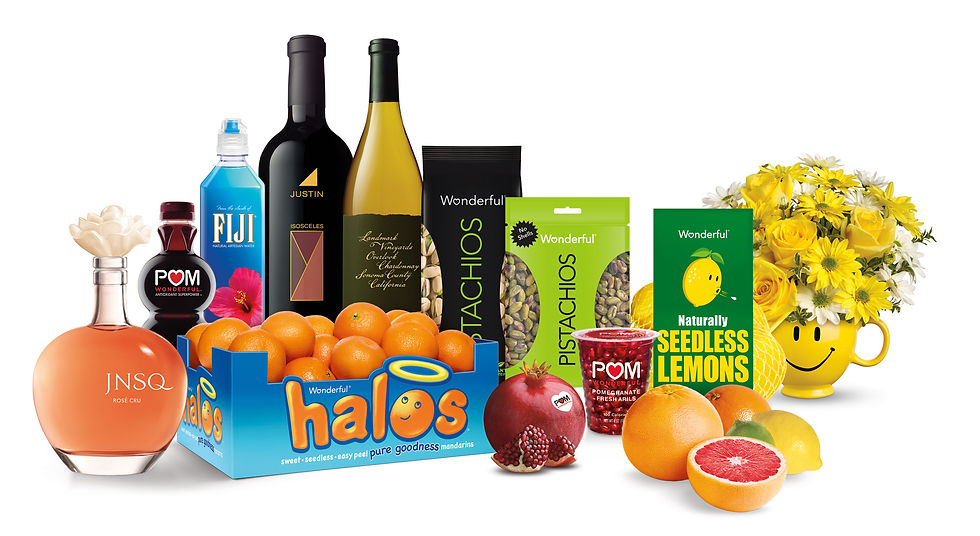
The Wonderful Company represents a different model: vertical integration paired with modern brand building. Founded by Stewart and Lynda Resnick, the company built its $6 billion business by owning the land and water rights necessary to control the supply chain, then turning commodities into premium brands like Wonderful Pistachios, POM Wonderful, and FIJI Water.
What makes Wonderful unique is its willingness to invest heavily in advertising to create entirely new consumer behaviors. Pistachios, for example, were repositioned from a bulk commodity to a branded snack through sustained marketing investment, including national campaigns and celebrity partnerships.
Because the company controls the production from the ground up, it can support marketing with strong margins and consistent supply even during market volatility. Private ownership allows them to make these capital-intensive bets without the need for immediate payback, building a moat that is as much about physical assets as it is about brand power.
Red Bull: The Ultimate Brand-Led Growth Engine

Red Bull is one of the most successful examples of brand-driven growth in modern CPG. Launched in 1987, it created and dominated the energy drink category through a combination of product focus and unprecedented investment in marketing and culture. In 2025 alone, the company sold a record 13.9 billion cans worldwide!
Red Bull famously reinvests roughly 25% to 30% of its revenue—an estimated $3.7 billion annually—into marketing, far above typical CPG norms. But that spend is not traditional advertising; it is a sprawling ecosystem of content, extreme sports events, Formula 1 teams, and media ownership that reinforces the brand’s identity.
Remaining private has allowed Red Bull to maintain this strategy without pressure to reduce spend or shift toward short-term performance metrics. The result is a brand that commands both premium pricing and a leading global market share of over 40%, proving that a private company can out-market almost anyone by prioritizing brand equity over quarterly dividends.
What Private Ownership Actually Changes
It is easy to assume that private companies are more nimble. At this scale, that is not true. Mars and Ferrero are not moving faster than PepsiCo or Hershey on a day-to-day basis.
What private ownership changes is not speed, but orientation.
Private companies can:
View advertising as a long-term asset: They treat brand-building as a non-negotiable investment rather than a variable expense to be cut when a quarter gets tight.
Commit to rebuilding brands: Instead of divesting underperformers for a quick balance sheet win, they have the runway to reformulate and relaunch them.
Prioritize heavy infrastructure: They make the kind of capital-intensive bets in supply chain and sustainability—like land rights or regenerative farming—that take decades to pay off.
Expand for the long game: They can enter new categories or pull off major acquisitions without the immediate pressure of justifying ROI to a volatile market.
Across this group, advertising plays a consistent role. These companies do not underinvest in brand. If anything, they over-index on it, maintaining strong share of voice and using media to reinforce long-term positioning rather than drive short-term spikes.
The Reality of Reaching Scale
There is a reason this list is short. Building a billion-dollar CPG brand while remaining private is difficult.
It requires:
Time measured in decades, not years
Access to capital without external pressure
Strategic clarity on where to compete
A willingness to stay the course through volatility
It also requires some degree of luck. Category timing, distribution access, and competitive dynamics all play a role.
Most brands do not follow this path. They sell to larger players or take on investors as they scale. The ones that remain independent tend to have a structural advantage, whether that is supply chain control, category creation, or exceptional brand power.
The Takeaway From the Largest Private CPG Companies
Privately owned CPG companies can absolutely compete with the largest public brands—and as we’ve seen recently, they are sometimes the ones acquiring them. But they do so differently.
They are not faster. They are not necessarily more efficient in the short term. What they are is patient, consistent, and willing to invest ahead of demand.
That combination, over time, is what turns a small candy business, a regional potato processor, or a niche energy drink into a global category leader.
Hi! We’re Left Hand Agency. We help CPG brands build growth strategies that win today and scale tomorrow across retail, media, and measurement.


