Retail Sales Velocity: Why Sales Can Go Up While Velocity Goes Down
As part of our ongoing series on growth and measurement for CPG brands, we’re continuing our exploration of retailer-facing metrics.
In our last post, we discussed why retailers care about velocity, not your ROAS. Now we’re going one level deeper into a scenario that creates real tension inside organizations.
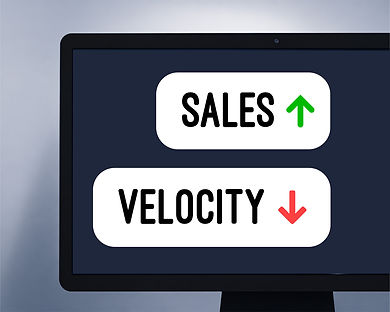
Sales are up.
Velocity is down.
At first glance, that feels impossible.
It’s not.
How This Happens
There are a few common ways total sales can increase while velocity weakens.
Expanded distribution
Heavier promotions
Short-term retail media pushes
Seasonal spikes
Let’s walk through the most common scenario.
If your brand expands into 2,000 new stores, total revenue will likely increase. But if sales per store are lower in those new locations than in your core base, average velocity declines.
From an internal perspective, revenue growth looks positive.
From a retailer’s perspective, rate of sale per store looks softer.
Both can be true at the same time.
The Distribution Illusion
Distribution growth is often celebrated as expansion, and it should be.
But distribution without demand can dilute performance.
Think about it like this: if marketing is not building sufficient awareness and mental availability in newly expanded regions, velocity may suffer even as total revenue rises.
This is something retailers notice quickly.
They compare your rate of sale against category benchmarks and competing SKUs. If your product is underperforming per store, additional space becomes harder to defend.
Distribution should amplify demand, it shouldn't mask weak demand.
Promotions Can Distort the Picture
Promotions create another version of this tension.
Discounting can:
Drive short-term volume
Increase retail orders
Improve shipment numbers
But promotions often pull demand forward rather than create new demand.
After the spike, baseline velocity can soften.
Retail buyers understand this dynamic and evaluate performance beyond promotional windows. If a product only moves when discounted, long-term shelf confidence erodes. And if done too often, they can train the customer to wait for the next promotion.
From a finance perspective, heavy promotions also compress margin.
So even when revenue rises, risk may be increasing underneath.
Retail Media Can Inflate the Signal

Retail media is powerful for capturing demand.
When brands invest heavily in onsite placements, search ads, or retailer-owned display, sales often rise inside that environment.
But if retail media spend is not accompanied by broader reach efforts, it may concentrate impact among high-propensity shoppers, which can increase total sales without expanding the buyer base.
Over time, velocity may plateau because the same audience is being reached repeatedly.
This is the performance plateau in action. Sales can grow temporarily while structural expansion stalls.
Why This Scenario Creates Internal Conflict
When sales are rising, marketing feels validated. When velocity is declining, sales teams feel pressure. When promotions increase, finance sees margin risk.
All three are reacting to different signals.
Without a shared measurement framework, the conversation becomes reactive.
Is marketing over-spending?
Is sales over-discounting?
Is distribution too aggressive?
The real question is more structural: Are we building demand at the same rate we are expanding availability?
How to Diagnose the Situation

When sales increase but velocity softens, it’s worth stepping back and asking:
Has distribution expanded faster than awareness?
Are promotions driving short-term volume spikes?
Is retail media capturing existing demand without expanding reach?
Is household penetration growing, or are we relying on repeat buyers?
Velocity alone doesn’t provide those answers.
But it does signal that something deserves investigation.
When It’s a Healthy Tradeoff
It’s important to note that not all velocity declines are bad.
Early-stage expansion often temporarily lowers average rate of sale while a brand builds awareness in new regions.
That can be strategic.
The difference is whether demand-building investment is keeping pace with distribution growth.
If brand-building and reach are layered appropriately, velocity often stabilizes over time.
If not, the brand risks becoming promotion-dependent to maintain shelf performance.
What Retailers Are Really Watching in Retail Sales Velocity
Retailers are not simply tracking your total revenue.
They are closely monitoring retail sales velocity because it helps them understand whether your product is generating sustainable demand at the shelf level.
They are watching:
Rate of sale
Category contribution
Relative performance versus competitors
Sustained, non-promotional demand
Velocity is their proxy for long-term confidence.
If it erodes, the conversation changes quickly.
The Bigger Lesson
Sales growth is not always synonymous with healthy growth because revenue can rise while underlying fragility increases. Velocity is often the early warning sign.
When paired with incremental lift, penetration, and brand health, it helps reveal whether growth is:
Expanding sustainable
Artificially inflated
In our next post, we’ll move from diagnosis to action: what to do when a retailer tells you your velocity is soft.
We are Left Hand Agency, a CPG media buying agency helping brands grow with short and long-term strategies. Our memory-driven strategies deliver results your marketing and finance teams will champion.